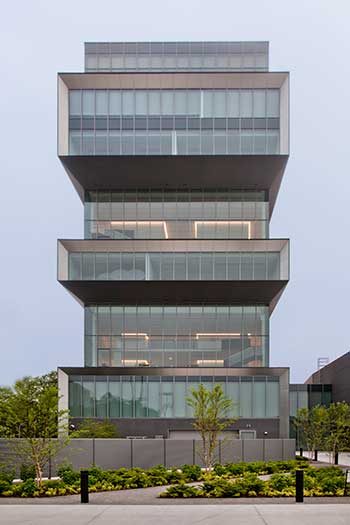
Green Building Design
We were green before green was cool.

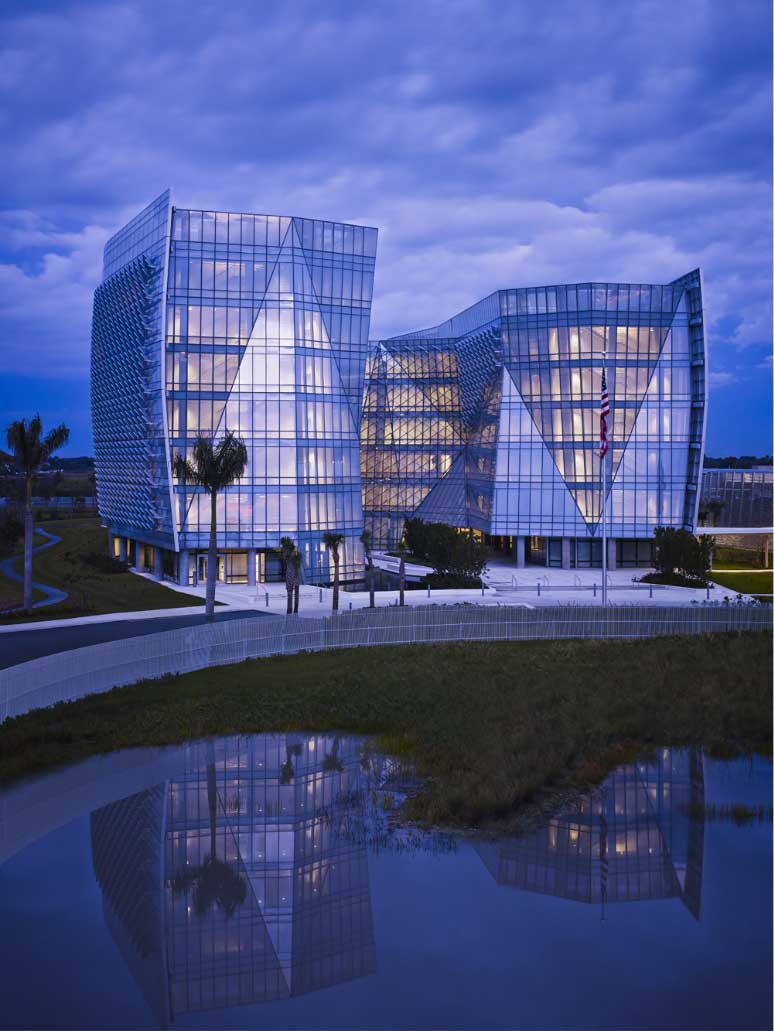
The Rock and Roll Hall of Fame
Cleveland, Ohio
Type of glass: VE1-2M
Architect: Gensler
Photographer: Wes Thompson
The Rock and Roll Hall of Fame
opened in 1995 incorporating Viracon
sustainable glass technology.
Green building design has become a major influence these days. But that's nothing new at Viracon-it's been our focus for over 37 years. Today you can select from over a hundred sustainable architectural glass alternatives, as well as tap into design help and technical expertise, to meet strict LEED® credit requirements. All without compromising aesthetics or energy efficiencies. How cool is that?

Sustainable Design
Designing to meet the needs of the present without compromising the ability of future generations to meet their needs.
The U.S. Green Building Council (USGBC)
The U.S. Green building council is an organization of leaders from across the building industry working to produce a new generation of high performance building through promoting buildings that are environmentally responsible, profitable and healthy places to live and work.

Leadership in Energy and Environmental Design (LEED®)
LEED® is a rating system developed by the USGBC as a national standard for high performance sustainable buildings. It was created to define green building through a standard of measurement and raise consumer awareness of green building benefits.

For the previous version, LEED NC Version 2.2, please click here.

The latest version, LEED 2009, covers design, construction and major renovations of commercial and institutional buildings including core and shell and K-12 school projects. Within LEED 2009, there are four levels of certification:

• Certified: 40-49 points
• Silver: 50-59 points
• Gold: 60-79 points
• Platinum: 80 points and above


There are 100 base points, 6 possible Innovation in Design and 4 Regional Priority points. The points cover the entire building process including everything from site selection all the way through building occupancy and are broken into 5 base categories and 2 bonus categories.

Out of the seven total categories, glass selection may be able to help in four; Energy and Atmosphere (EA), Materials and Resources (MR), Indoor Environmental Quality (IEQ) and Innovation in Design Process (ID). The following illustrates which credits glass may affect within each category.

Energy & Atmosphere (EA)
There are three prerequisites in the Energy and Atmosphere category. A prerequisite is worth no points, however they must be done in order to achieve any LEED® certification. In addition to the prerequisite there are six credits. In the LEED® rating system a credit is not the same as a point. A credit is essentially an area of emphasis within the category, each credit has a set number of points available within it. Glass selection may be able to help with one of the three prerequisites and one of the six credits in this area.

EA Prerequisite 2: Minimum Energy Performance
Option 1 requires software energy simulation; Options 2 and 3 do not require modeling.

  • Option 1- Whole Building Energy Simulation
    Demonstrate at 10% improvement in the proposed building performance rating for new buildings. Calculate the baseline building performance rating according to the building performance rating method in Appendix G of ANSI/ASHRAE/IESNA Standard 90.1-2007 using a computer simulation model for the whole building project. See Section 5 of the Standard for the specific Building Envelope Requirements.

  • Option 2- Prescriptive Compliance Path: Advanced Energy Design Guide
    This option only applies to office buildings or retail buildings under 20,000 square feet, small warehouses under 50,000 square feet or schools under 200,000 square feet.

  • Option 3- Prescriptive Compliance Path: Advanced Buildings Core Performance Guide
    This option only applies to projects less than 100,000 square feet. Healthcare, warehouse and laboratory projects are ineligible for this path.
EA Credit 1: Optimize Energy Performance, 1-19 points possible for NC and Schools, 3-21 points for CS
Select one of the following three compliance paths. Option 1 requires software energy simulation; Options 2 and 3 do not require modeling. Achieving points through any of the three options assumes compliance with EA Prerequisite 2: Minimum Energy Performance.

  • Option 1 - Whole Building Energy Simulation (1-19 points possible for NC and Schools, 3-21 points for CS)
    Demonstrate a percentage improvement in the proposed building performance rating compared with the baseline building performance rating according to ANSI/ASHRAE/IESNA Standard 90.1-2007 using a computer simulation model for the whole building project. The further the Standard is exceeded the more points are achieved. For example, exceeding the standard by 14% provides 2 points, 22% 6 points, etc. all the way to a maximum of 19 points available for exceeding the standard by 48%.

  • Option 2- Prescriptive Compliance Path: Advanced Energy Design Guide (1 point)
    This option only applies to office buildings or retail buildings under 20,000 square feet, small warehouses under 50,000 square feet or schools under 200,000 square feet.

  • Option 3- Prescriptive Compliance Path: Advanced Buildings Core Performance Guide (1-3 points)
    This option only applies to projects less than 100,000 square feet. Healthcare, warehouse and laboratory projects are ineligible for this path. One point is available of projects complying with Sections 1 and 2 of the Core Performance Guide and up to two additional points for implementing strategies in Section 3.
Glass Products for EA Prerequisite and Credit 1
Exceeding ASHRAE 90.1-2007 involves more than just selecting a glass product. First, it is necessary to decide the goal. By what percentage will the building’s efficiency need to exceed ASHRAE? This percentage improvement will help determine, typically through energy modeling, the specific glass performance requirements. Once you have these requirements, feel free to contact us to help find products that will meet your requirements. You can also narrow down the options through the use of our Climate Zone Chart or our performance data tables. For example, the insulating chart has options along the left side for you to select a specific SHGC range.


Climate Zone Chart (PDF)

Materials & Resources (MR)
There is one prerequisite along with seven credits available in Materials and Resources. Glass selection may be able to help with two of the seven credits in this area.

MR Credit 4: Recycled Content, 2 points possible
Specify materials with recycled content

LEED 2009 shall be defined in accordance with the International Organization of Standards document – ISO 14021 – Environmental labels and declarations-self-declared environmental claims (Type II environmental labeling). Preconsumer material is defined as material diverted from the waste stream during the manufacturing process. Reutilization of materials (i.e., rework, regrind, or scrap generated in a process capable of being reclaimed within the same process that generated it) is excluded.

Glass Products for MR Credit 4
Float glass used in commercial applications contains recycled material, however, per the USGBC definition, waste generated within the float manufacturing process is specifically excluded from being counted toward recycled content. The only content meeting the definition of recycled content is glass returned to a float manufacturer from another source, such as a fabrication facility. Exact percentages vary by manufacturer and are deemed proprietary. As a result, Viracon's glass products contain recycled content, but do not contribute to this credit per LEED® guidelines.

MR Credit 5: Regional Materials, 2 points possible
Specify materials that have been extracted, harvested or recovered, as well as manufactured within 500 miles of the project site.

Glass Products for MR Credit 5
The material Viracon uses in the glass fabrication process comes from a variety of suppliers. Each supplier uses raw materials extracted from multiple locations. It is not possible, with the current fabrication systems, to track each fabricated glass unit back through these processes to a specific point of extraction.

Viracon has three manufacturing facilities: Owatonna, MN, Statesboro, GA, and St. George, UT

Indoor Environment(IEQ)
There are three prerequisites along with ten credits available in the Indoor Environmental Quality category. Glass selection may be able to help with one of the credits in this area.

IEQ Credit 8.1: Daylight and Views - Daylight, 1 point possible NC and CS, 1-3 points for Schools
For NC and CS, daylight 75% of regularly occupied spaces. Compliance determined through one of four methods:

  • Option 1 - Simulation
    Demonstrate through computer simulations that 75% of all regularly occupied spaces achieve daylight illuminance levels of a minimum of 25 footcandles (fc) and a maximum of 500 fc

  • Option 2 - Prescriptive
    Comply with requirements outlined in LEED Reference Guide for Green Building Design and Construction.

  • Option 3 - Measurement
    Demonstrate through records of indoor light measurements that a minimum daylight illumination level of 25 fc has been achieved in at least 75% of all regularly occupied spaces.

  • Option 4 - Combination
    Any of the above calculation methods may be combined to document the minimum daylight illumination
For Schools, daylight 75% of the classrooms for 1 point, 90% for two points and 75% of all other regularly occupied spaces for 1 additional point.

Glass Products for EQ Credit 8.1
Daylighting is best achieved through an integrated design approach. Computer simulation can provide valuable input by showing the combined effects of multiple windows within a daylit space. The visible light transmittance of the glazing should be taken into consideration.

Using clear glass may not be the best solution, daylighting is about selecting the right amount of light, not the most light possible. When too much light is introduced glare becomes a concern. The USGBC offers the following list of common strategies to control glare; fixed exterior shading devices, exterior light shelves, interior light shelves, interior blinds and louvers, operable draperies and blinds, fritted glazing and electronic blackout glazing.

Note: Adding large spans of glass can increase the risk of birds flying into the glass. In areas where this is a concern treat the window glazing through the use of exterior shading devices or introduce patterns on the glass, such as a ceramic frit silk-screen pattern to help reduce the risk.

EQ Credit 8.2 – Daylight and Views, 1 point possible
Achieve a direct line of sign to the outdoor environment via vision glazing between 30 inches and 90 inches above the finish floor for building occupants in 90% of all regularly occupied areas.

Glass Products for EQ Credit 8.2
Viracon offers an extensive line of vision glazing products including insulating units, laminated, silk-screened, etc. Each of these products can be used to provide the appropriate amount of daylight so the use of glass can be extended throughout the building.

Innovation in Design (ID)
There are three credits available in the Innovation in Design category. Glass selection may be able to help with one of the credits in this area.

ID Credit 1 – Innovation in Design, 1-5 points possible NC and CS, 1-4 points for Schools
Using an innovative technology or achieving exemplary performance

  • Path 1 – Innovation in Design, 1-5 points for NC and CS, 1-4 points for schools
    One point for each innovation

  • Path 2 – Exemplary Performance, 1-3 points
    May be earned for achieving double the credit requirements and/or achieving the next incremental threshold of an existing credit in LEED.
Need Additional Assistance?
Please contact us at 800-533-2080.
 

VOC Content


For complete information on LEED® and its certification process, access the USGBC website at http://www.usgbc.org/leed.